🧾 Button Specifications in Garment Production: Placement, MOQ, and Supplier Management
Accurate button specifications are essential for efficient garment production, cost control, and quality consistency. In professional product development, button details must be clearly documented in the process sheet and materials catalog to avoid errors, delays, and unnecessary costs.
This guide explains how to specify button placement, size (linen system), finish, quantity, and Minimum Order Quantity (MOQ) — especially important for apparel manufacturers and sourcing teams.
🔹 Why Button Specifications Matter
Buttons may seem small, but specification errors can cause:
- ❌ Production delays
- ❌ Incorrect size or finish
- ❌ Excess inventory costs
- ❌ MOQ over-purchasing
- ❌ Inconsistent garment appearance
Clear documentation ensures that factories, suppliers, and merchandisers work with the same technical standards.
🔸 What Must Be Included in the Process Sheet
A complete button specification section should include:
| Specification Item | Description |
|---|---|
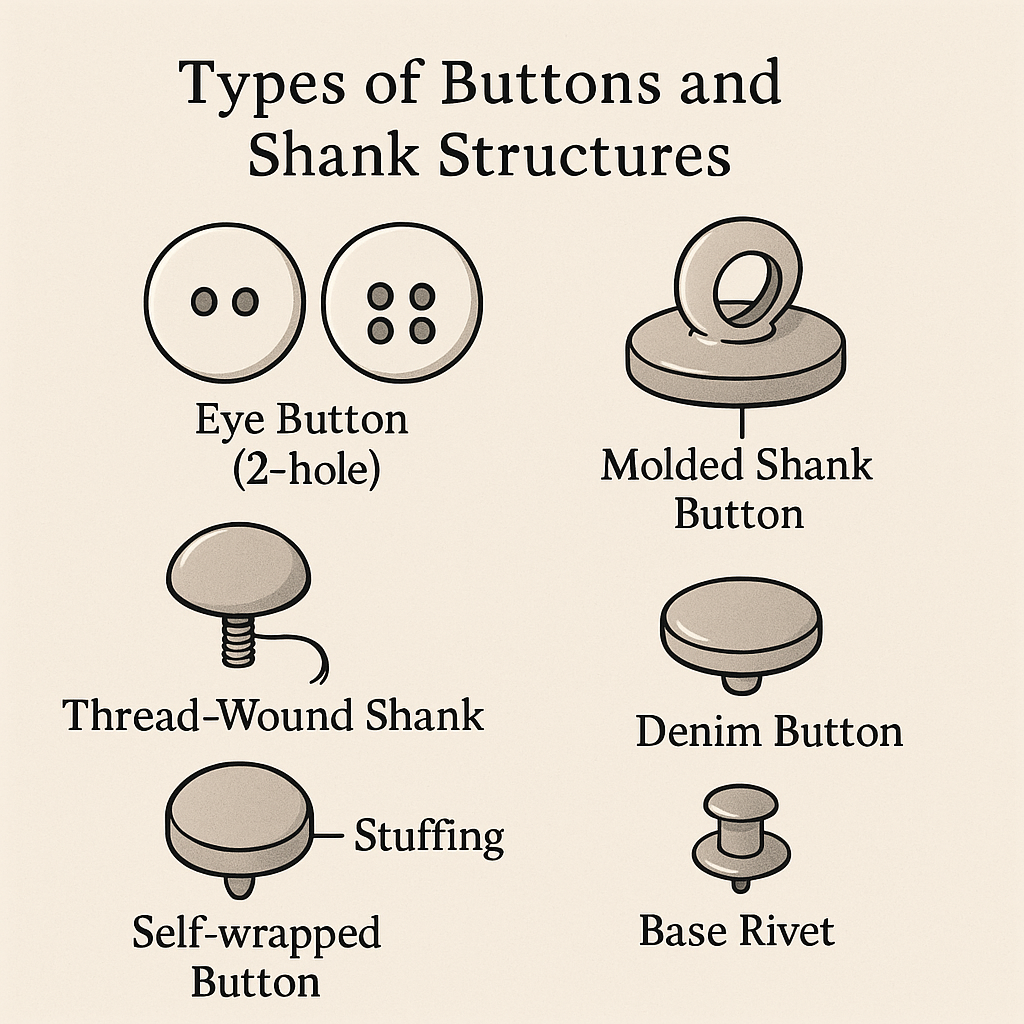
| Button Type | 2-hole, 4-hole, shank, decorative, etc. |
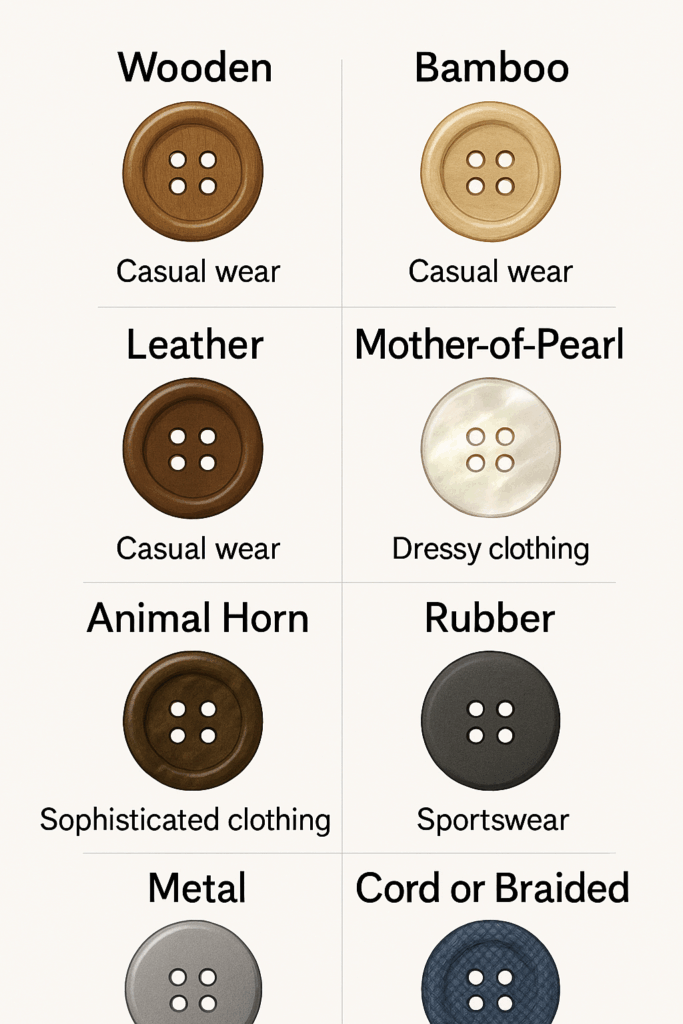
| Material | Plastic, horn, shell, metal, etc. |
| Size | Expressed in linen (L) |
| Finish | Matte, glossy, polished, textured |
| Placement | Front placket, sleeve vent, collar, etc. |
| Quantity per Garment | Number of buttons per location |
| Spare Buttons | Usually 1 extra included |
| Supplier | Name of approved vendor |
| MOQ | Minimum order quantity requirement |
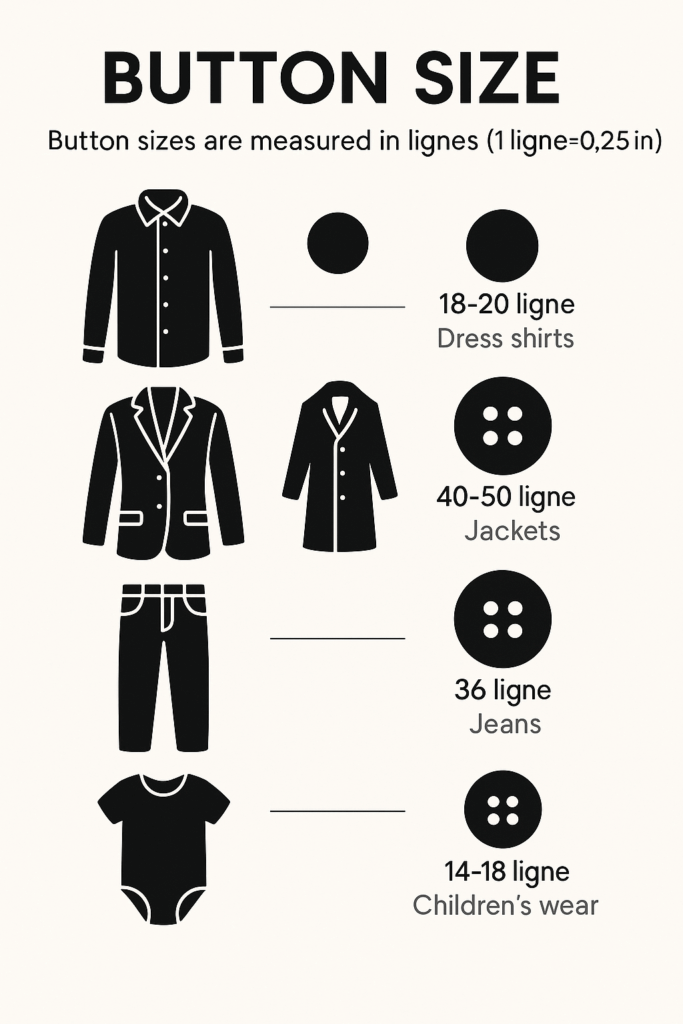
🔹 Understanding Button Size in Linen (L)
Button size is commonly expressed in linen (L).
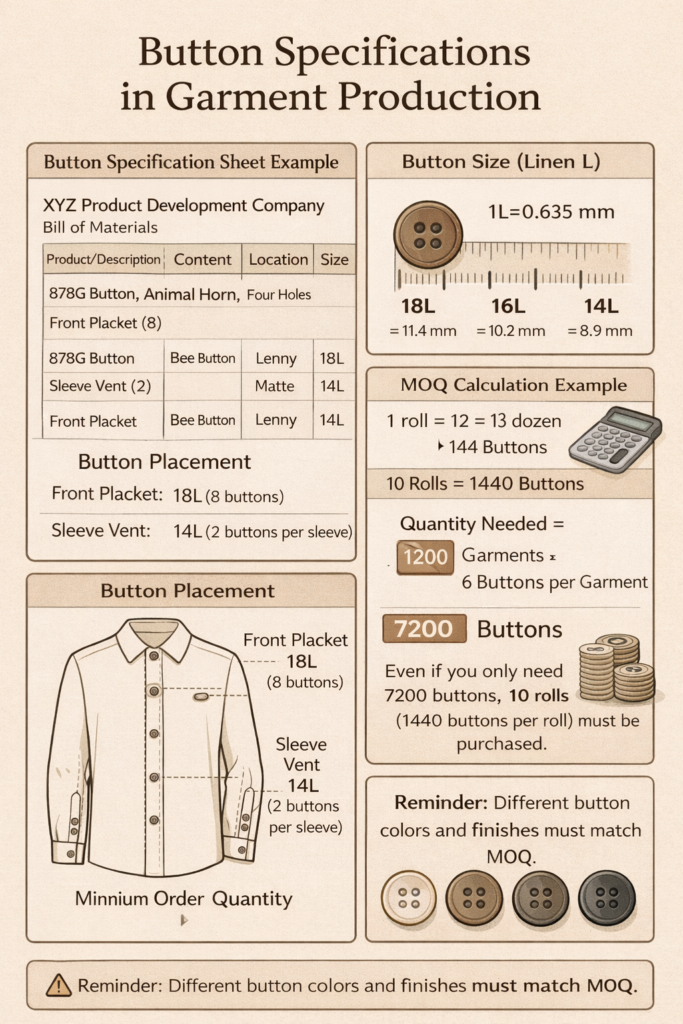
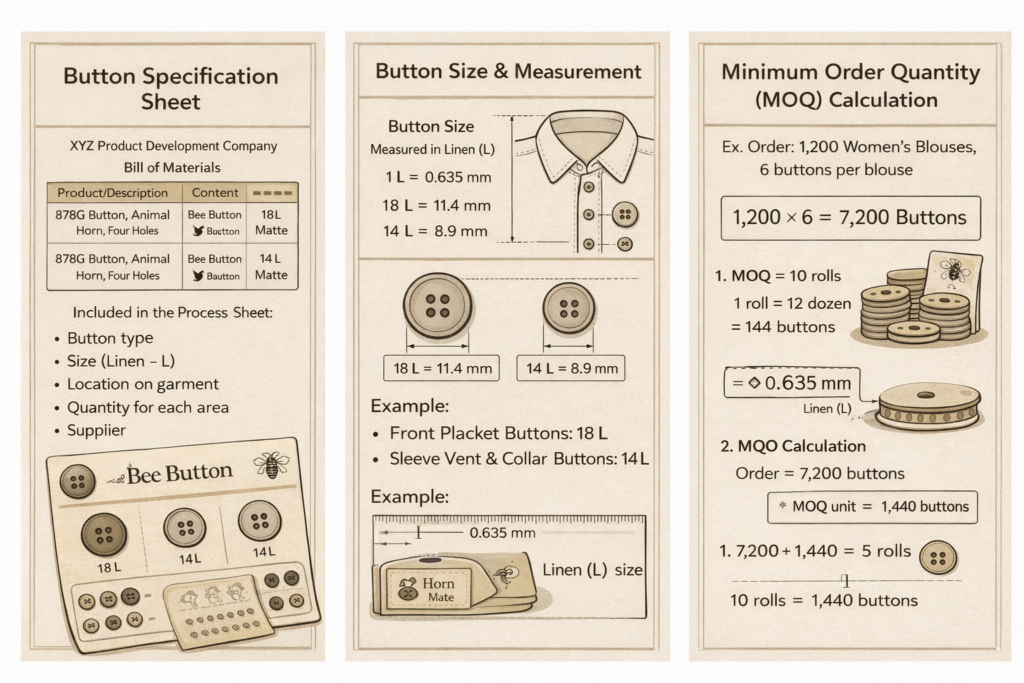
- 1L = 0.635 mm
- 18L ≈ 11.4 mm
- 14L ≈ 8.9 mm
Example:
- Men’s shirt front placket → 18L buttons
- Sleeve vent or collar → 14L buttons
📌 Matte finishes are often preferred for men’s shirts to achieve a refined, understated look.
🔸 Example: Button Specification Breakdown
Men’s Shirt Example
| Location | Button Type | Size | Finish | Quantity |
|---|---|---|---|---|
| Front Placket | 4-hole horn button | 18L | Matte | 8 + 1 spare |
| Sleeve Vent | 4-hole horn button | 14L | Matte | 2 + 1 spare |
| Collar | 4-hole horn button | 14L | Matte | 2 |
This information must match both:
- The technical package
- The materials catalog
- The supplier sample book
🔹 Understanding Minimum Order Quantity (MOQ)
MOQ is the minimum quantity required by the button supplier.
For example:
- MOQ = 10 rolls
- 1 roll = 12 dozen
- 1 dozen = 12 buttons
→ 1 roll = 144 buttons
→ 10 rolls = 1,440 buttons
⚠️ Even if you only need 1,200 buttons, you may be required to purchase 1,440.
🔸 MOQ Calculation Example
Order:
- 1,200 women’s blouses
- 6 buttons per blouse
Total required:
1,200 × 6 = 7,200 buttons
If MOQ unit = 1,440 buttons:
7,200 ÷ 1,440 = 5 rolls exactly → ✔ Efficient order
But if order is 1,150 pieces:
1,150 × 6 = 6,900 buttons
MOQ requires rounding up to 7,200 or 8,640 depending on roll size.
📌 Precise MOQ planning prevents unnecessary stock and cost increase.
🔹 Special Considerations for Small vs Large Companies
Large Manufacturers:
- Can absorb surplus MOQ
- Use same buttons across multiple styles
- Maintain long-term supplier contracts
Small Companies:
- Must carefully match order quantities to MOQ
- May need to consolidate colorways
- Should confirm MOQ before finalizing button selection
⚠️ If multiple colors are used, each color must meet MOQ individually.
🔸 Replacement & Development Samples
During product development:
- Suppliers provide sample buttons
- Replacement buttons are prepared for showroom or sales samples
- Buttons may be custom-made according to development samples
📌 Always request:
- Physical color confirmation
- Finish approval
- Size tolerance check
- Wash test validation
✅ Button Specification Checklist for Product Developers
Before bulk approval, confirm:
- ✔ Correct linen size
- ✔ Placement matches tech pack
- ✔ Quantity includes spare button
- ✔ MOQ aligns with production quantity
- ✔ Finish suits target market (matte vs glossy)
- ✔ All colorways meet MOQ separately