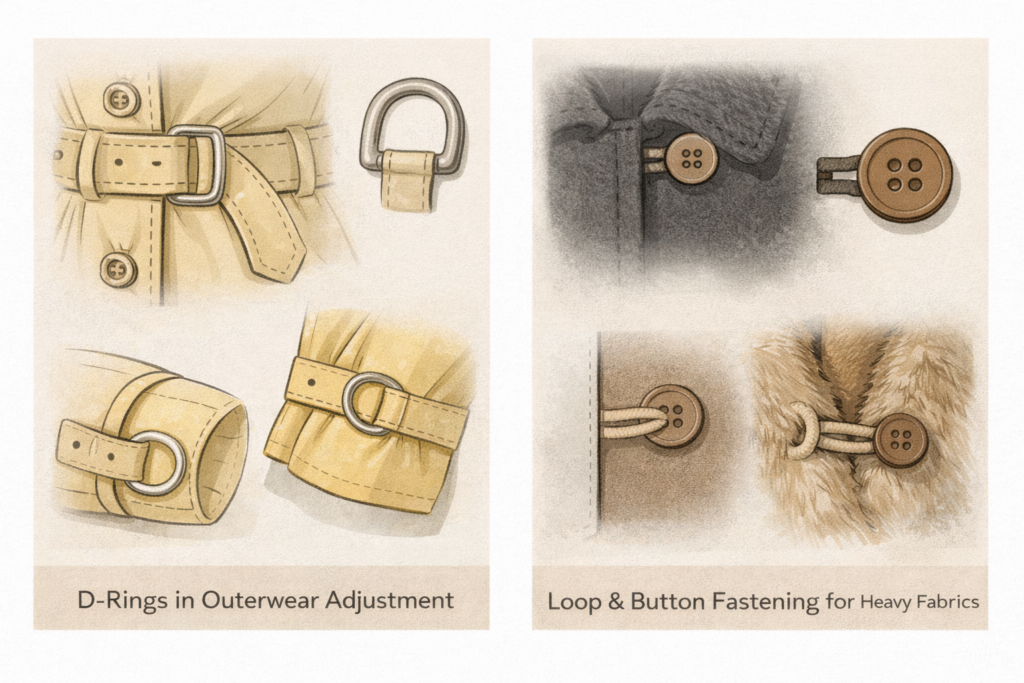
🔗 D-Rings and Loops in Garment Design: Functional Adjustments for Heavy and Outerwear
D-rings and fabric loops are essential structural components in outerwear and heavy garments. Unlike traditional buttons and buttonholes, these fastening systems provide adjustable tension, durability, and design flexibility — especially in coats, rainwear, and wool garments.
For garment manufacturers and product developers, understanding when and how to use D-rings and loops improves both functionality and garment longevity.
🔹 What Is a D-Ring in Apparel?
A D-ring is a metal fastening ring shaped like the letter “D.” It is typically attached to:
- Drawstrings
- Belts
- Waist tabs
- Cuff straps
- Adjustable closures
✅ Common Applications of D-Rings:
| Garment Type | Application |
|---|---|
| Raincoats | Waist adjustment |
| Trench coats | Belt fastening |
| Jackets | Cuff tightening |
| Outdoor garments | Drawstring control |
| Utility wear | Adjustable tabs |
D-rings allow quick tension adjustment without complex stitching. They are particularly useful in water-resistant garments where traditional buttonholes may weaken the fabric.
🔸 Why D-Rings Are Ideal for Raincoats
Rainwear fabrics often include:
- Coated materials
- Laminated textiles
- Waterproof membranes
These fabrics:
- Cannot easily support traditional buttonholes
- May fray or weaken with repeated stitching
D-rings provide:
- ✔ Secure adjustment
- ✔ Reduced fabric strain
- ✔ Clean, modern appearance
🔹 What Is a Loop Fastening System?
A loop fastening system uses two loops, one often attached to a button. Instead of passing a button through a stitched buttonhole, the loop fits over the button.
This system is ideal for:
- Heavy wool coats
- Fur garments
- Thick natural fibers
- Structured outerwear
Because these fabrics are:
- Too thick for precise buttonholes
- Prone to distortion
- Difficult to machine sew neatly
🔸 Why Loops Are Used in Heavy Fabrics
In garments like:
- Wool overcoats
- Faux fur jackets
- Cashmere coats
- Structured outerwear
Traditional buttonholes may:
- Appear bulky
- Be difficult to cut cleanly
- Lose shape over time
Loops:
- ✔ Prevent thick fabric cutting
- ✔ Reduce seam stress
- ✔ Offer smoother fastening
- ✔ Maintain garment structure
🔹 Button-Up Loop Systems (Alternative Closure)
In some heavy garments, designers use loop-and-button systems instead of classic buttonholes.
Advantages:
- Cleaner appearance
- Easier to sew on thick materials
- Decorative possibilities (braided loops, leather loops, cord loops)
- Less risk of tearing
This fastening style is often seen in:
- Traditional coats
- High-end outerwear
- Vintage-inspired designs
- Cultural garments
🔸 D-Rings vs Loops: Functional Comparison
| Feature | D-Ring | Loop |
|---|---|---|
| Material | Metal | Fabric / Cord |
| Function | Adjustable tension | Button fastening |
| Best for | Rainwear, belts | Heavy coats |
| Fabric thickness | Medium to coated | Thick / bulky |
| Durability | High | Moderate to high |
🔹 Product Development Considerations
When specifying D-rings and loops in a tech pack:
Include:
- Ring size (inner diameter in mm)
- Metal finish (matte, polished, antique)
- Color matching
- Stitch reinforcement details
- Placement measurement from edge
- Load-bearing test requirements
For loops:
- Loop length
- Loop thickness
- Fabric type (bias tape, cord, leather strip)
- Stitch type
- Reinforcement backing
🔸 Quality Control Tips
Before bulk production:
- ✔ Test tension resistance
- ✔ Check metal corrosion (for D-rings)
- ✔ Ensure loop elasticity is consistent
- ✔ Confirm symmetry and alignment
- ✔ Perform wear simulation