🔄 Velcro (Hook-and-Loop Fastener) in Garment Construction: Applications, Strength Selection, and Sewing Techniques
Velcro, also known as a hook-and-loop fastener, is one of the most practical and user-friendly fastening systems in modern garment manufacturing. It requires minimal force to close, offers adjustable fastening strength, and is particularly suitable for children’s clothing, adaptive wear, and detachable garment components.
This article explains Velcro types, sewing methods, reinforcement techniques, advantages, and limitations for professional garment production.
🔹 What Is Velcro (Hook-and-Loop Fastener)?
Standard Velcro consists of two textile strips:
- Hook side – a woven strip with small hooks
- Loop side – a woven or knitted strip with soft loops
When pressed together, the hooks catch the loops, creating a secure bond that can be easily separated.
🔸 Why Velcro Is Widely Used
Velcro fastening requires:
- ✔ Minimal finger strength
- ✔ No precise alignment like buttonholes
- ✔ Quick fastening and unfastening
- ✔ Adjustable positioning
This makes it ideal for:
| Application | Reason |
|---|---|
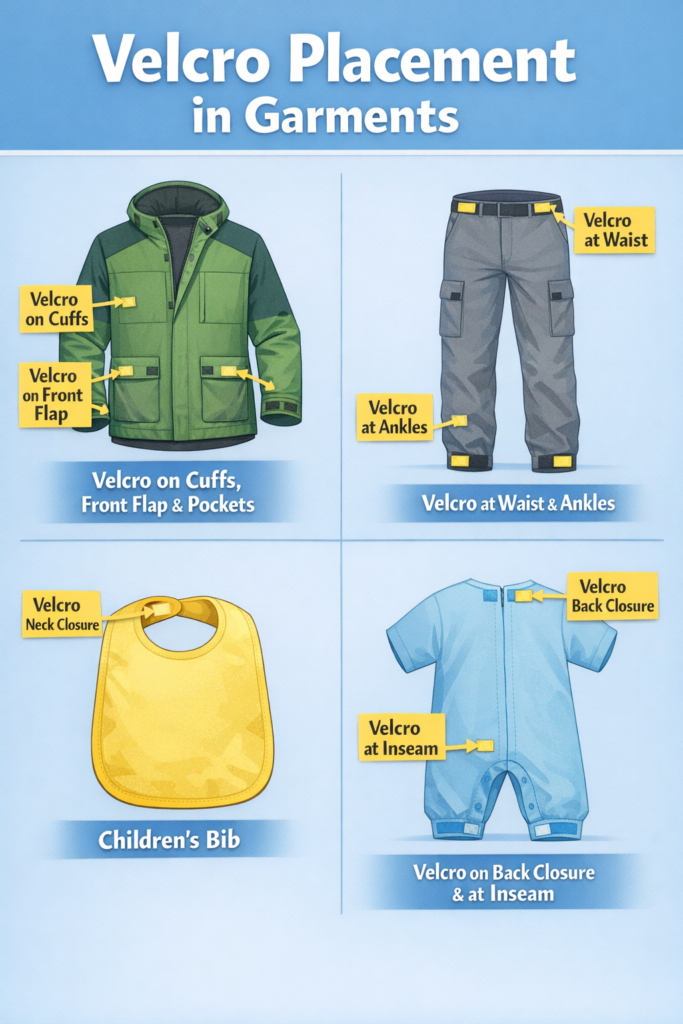
| Children’s clothing | Easy to operate, audible tearing sound |
| Adaptive wear | Suitable for limited mobility |
| Detachable cuffs | Easy removal |
| Collars & piping | Flexible adjustment |
| Pocket flaps | Secure closure |
🔹 Choosing the Correct Fastening Strength
Velcro comes in different grip strengths, depending on:
- Hook density
- Loop density
- Material stiffness
Stronger grip is used for:
- Outerwear
- Heavy garments
Softer grip is used for:
- Lightweight garments
- Skin-contact areas
- Children’s apparel
🔸 Sewing Techniques for Velcro
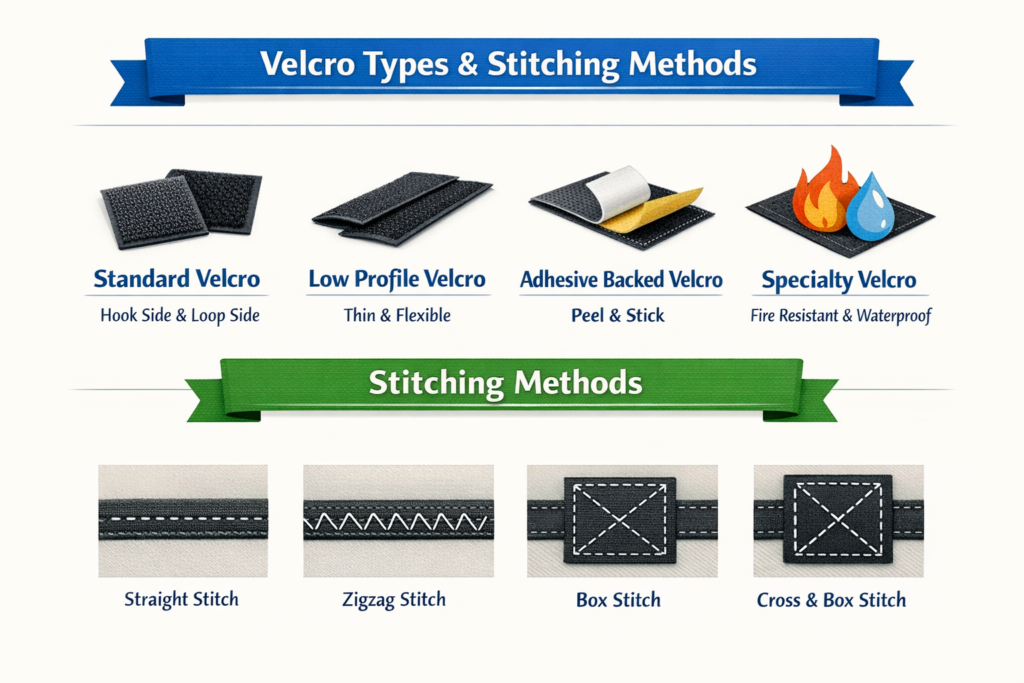
1️⃣ Standard Edge Stitching
- Stitch around the perimeter
- Recommended for most garments
- Reinforces edges to prevent peeling
2️⃣ X-Shaped Stitch Reinforcement
- X-shaped stitch through the center
- Used for high-stress applications
- Provides additional pull resistance
3️⃣ Adhesive-Backed Velcro
- Used for temporary positioning
- Must still be sewn for durability
For X-shaped Velcro applications, strong adhesive backing is required before stitching.
🔹 Special Sewing Considerations
When attaching Velcro:
- Trim sharp corners to prevent skin irritation
- Use rounded or oval shapes for children’s wear
- Conceal stitching on skin-contact areas
- Hide hook side inside fabric layers
For pocket flaps:
- Sew Velcro on the back of the flap for aesthetic cleanliness
- Reinforce stitching around the flap perimeter
🔸 Disadvantages of Velcro
Despite its advantages, Velcro has limitations:
| Issue | Explanation |
|---|---|
| Rigidity | Standard hooks are stiff |
| Thread snagging | Loose threads get caught |
| Not suitable for terry or lace | Loops stick to fabric |
| Appearance | Less formal than buttons |
⚠ Velcro should not be used on:
- Terry cloth
- Lace garments
- Highly textured fabrics
🔹 Alternative Soft Combination Method
Another approach is to sew both hook and loop sides on the same fabric edge. This method:
- Feels softer
- Reduces pilling
- Improves comfort
- Is more flexible than traditional overlapping Velcro placement
🔸 Placement Example: Trouser Fly
In some garments, Velcro may be used in trouser fly areas purely as reinforcement, not as the primary functional closure. This requires careful stress testing to ensure durability.
🔹 Quality Control Checklist
Before bulk production:
- ✔ Check corner sharpness
- ✔ Confirm grip strength
- ✔ Test opening cycles
- ✔ Inspect stitching durability
- ✔ Ensure hook side does not contact skin