🧵 Folded Buttons: Traditional Decorative Fastening in Garment Design
Folded buttons are a unique fastening technique that combines structure, craftsmanship, and cultural heritage. Unlike standard button-and-buttonhole systems, folded buttons rely on a loop-and-knot structure, making them both functional and highly decorative.
This elegant fastening style first appeared in traditional Chinese garments, where craftsmanship and symbolic design played an important role in clothing construction.
🔹 What Are Folded Buttons?
A folded button is created from:
- Cord
- Bias-cut fabric strips
- Decorative ribbon
- Matching garment fabric
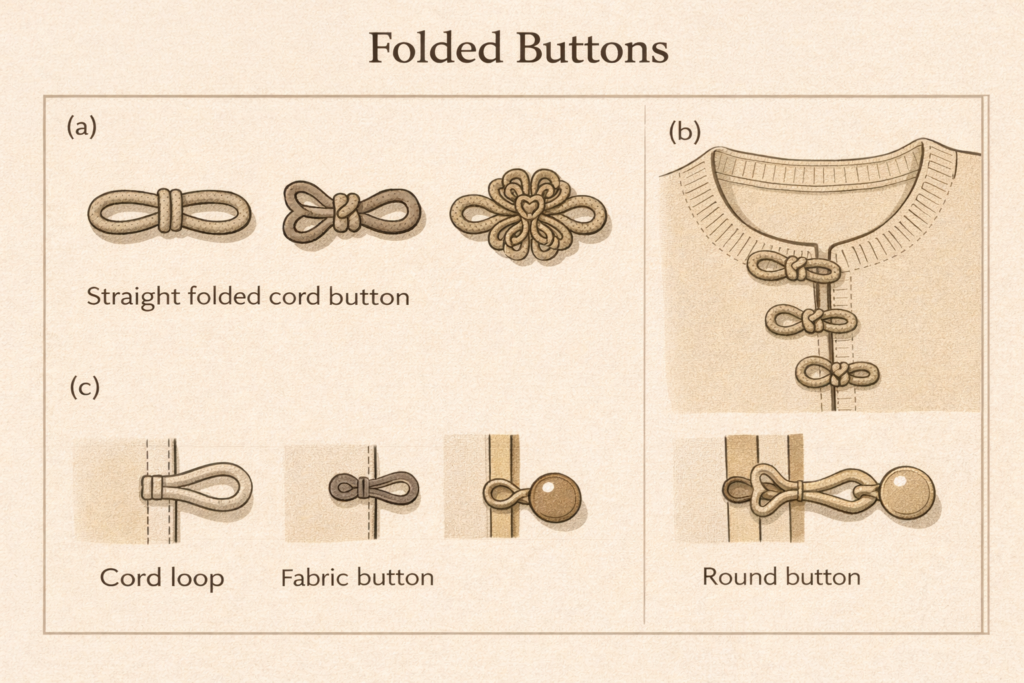
The fastening system consists of:
- A knotted decorative button
- A fabric loop made from the same material
The button passes through the loop to secure the garment — replacing traditional buttonholes.
🔸 Historical Origin
Folded buttons originated in traditional Chinese clothing, particularly in:
- Qipao (Cheongsam)
- Tang jackets
- Hanfu garments
- Traditional ceremonial attire
These buttons were often handcrafted and symbolized refinement, cultural identity, and artistry.
🔹 Types of Folded Buttons
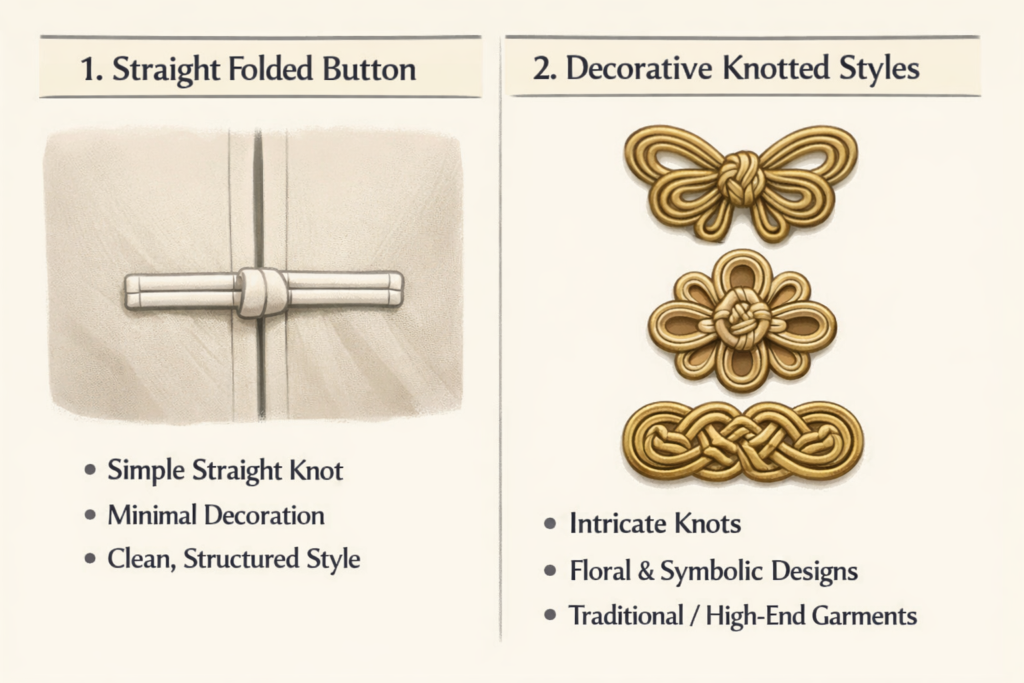
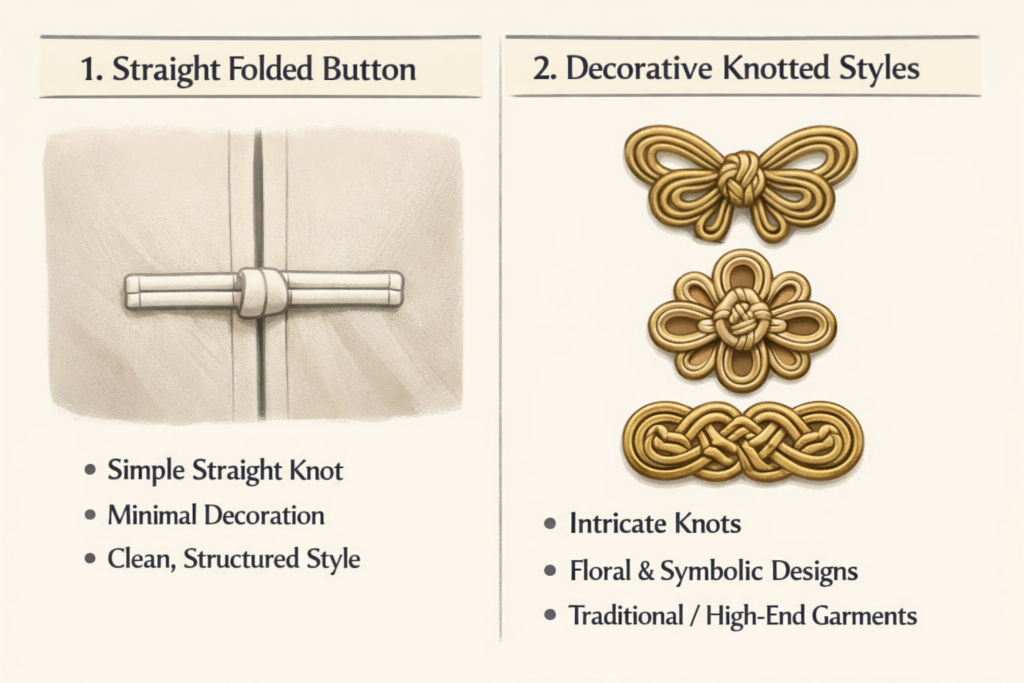
Figure-style references commonly include:
1️⃣ Straight Folded Button
- Simplest design
- Straight cord knot
- Minimal decorative twist
- Ideal for clean, structured garments
2️⃣ Decorative Knotted Styles
- Intricate symmetrical knots
- Floral or symbolic shapes
- Used in traditional or high-end garments
🔸 Application in Modern Fashion
Folded buttons are now commonly used in:
- Sweaters at the neckline
- Traditional-inspired jackets
- Decorative plackets
- Couture garments
- Eveningwear with ethnic detailing
Because they are soft and flexible, they work well on:
- Knitwear
- Silk
- Satin
- Lightweight wool
🔹 Structural Principle of Folded Buttons
The fastening principle remains consistent:
- Cord or fabric is folded and shaped into a knot.
- A loop of the same material is sewn into the placket seam.
- The knotted button passes through the loop.
- Tension is distributed across the seam instead of cutting a buttonhole.
This eliminates:
- Buttonhole fraying
- Structural weakening in delicate fabrics
- Bulky stitching on thick materials
🔸 Design Variation: Ribbon & Round Button Adaptation
In modern adaptations:
- The traditional cord may be replaced with decorative ribbon
- The central knot may be replaced by a round button
- The placket may use mixed materials for contrast
This maintains the folded-button principle while adapting to contemporary styling.
🔹 Advantages of Folded Buttons
| Feature | Benefit |
|---|---|
| No buttonhole cutting | Protects fabric integrity |
| Soft fastening | Comfortable for knitwear |
| Decorative | Enhances garment value |
| Cultural heritage | Adds storytelling element |
| Flexible structure | Suitable for curved plackets |
🔸 Production Considerations
When specifying folded buttons in a tech pack:
- Include cord diameter
- Specify fabric type
- Define loop length
- Indicate seam insertion method
- Reinforce loop anchoring inside seam
Proper anchoring prevents loop detachment, especially at neckline closures.