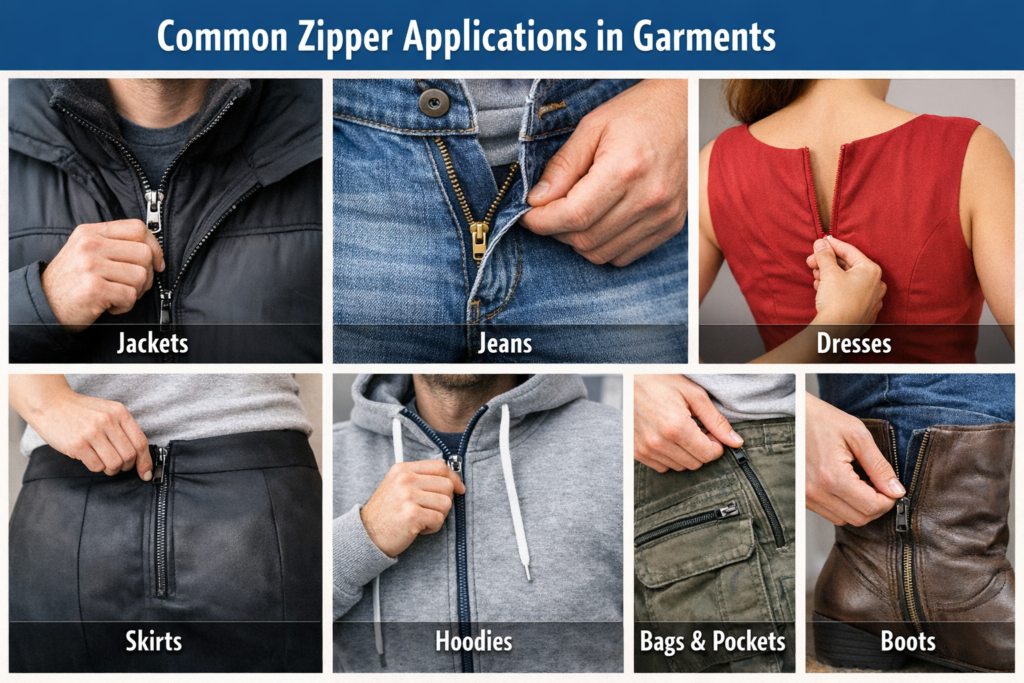
🔒 Zippers in Garment Design: Function, Structure, and Design Advantages
Zippers are one of the most practical and widely used fastening systems in modern garment construction. First introduced at the Chicago World’s Fair in the late 19th century, zippers gained widespread popularity after World War I and have since become essential in apparel manufacturing.
Today, zippers are especially valued in fitted garments, heavy fabrics, coats, and trouser fly constructions — and concealed zippers are even more prevalent in contemporary fashion.
🔹 Why Zippers Became Essential in Fashion
Zippers offer:
- ✔ Fast and convenient closure
- ✔ Smooth, gap-free fastening
- ✔ Clean and structured appearance
- ✔ Better tension control in fitted garments
- ✔ Strong performance in heavier fabrics
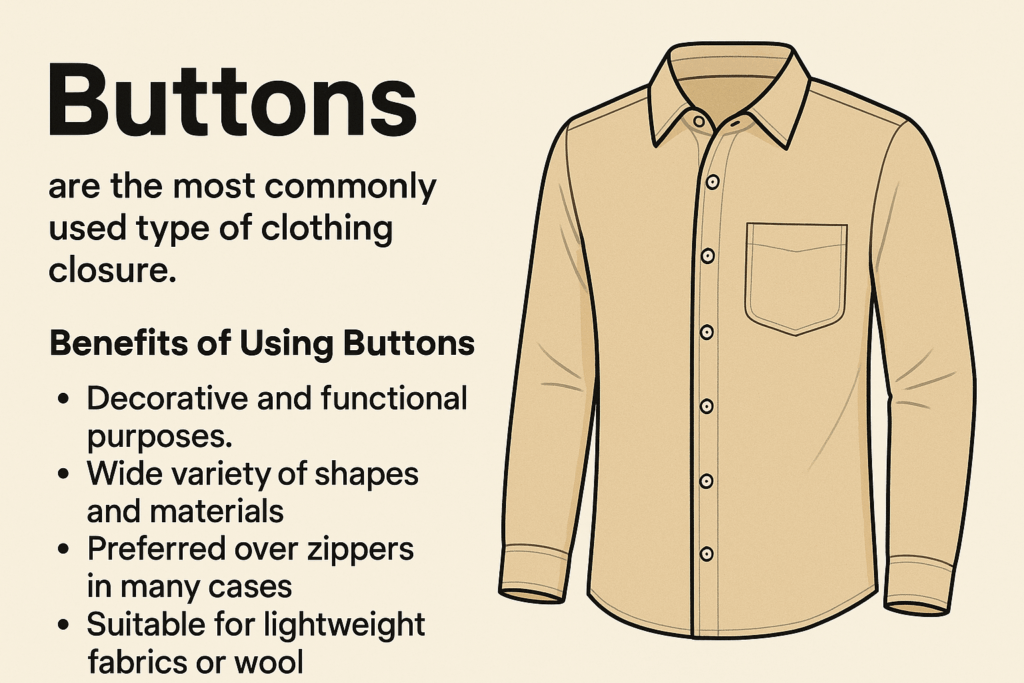
Compared to buttons, zippers create a continuous closure line without spacing gaps.
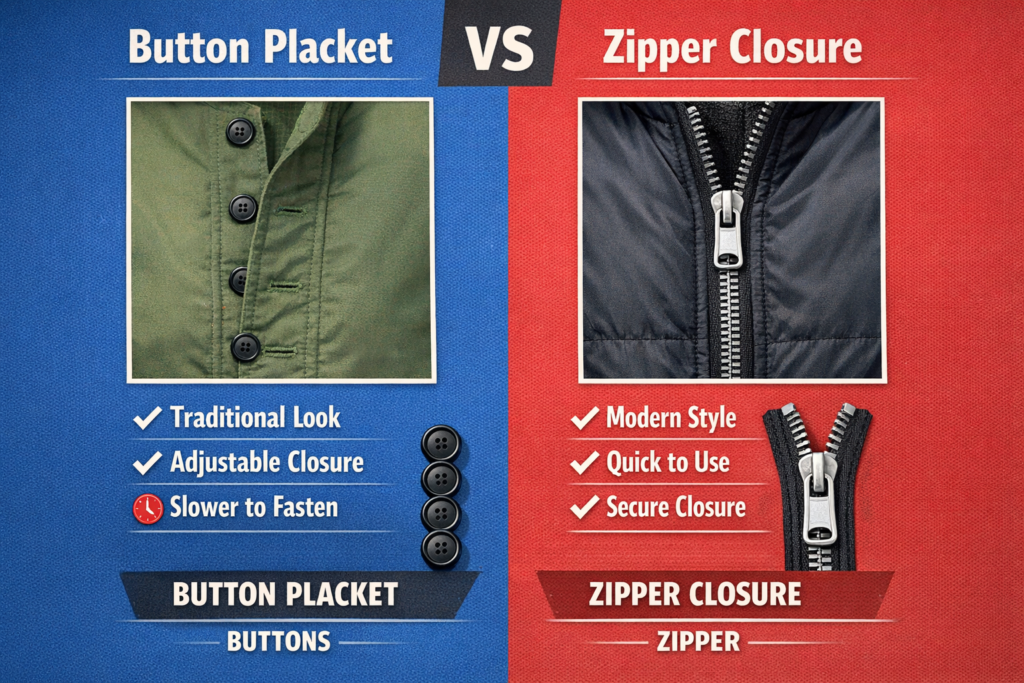
🔸 Zippers vs. Buttons: A Functional Comparison
In garments using buttons:
- Small gaps may appear between button placements
- Fitted garments may strain at plackets
- Additional buttons can reduce gaps but reduce convenience
In garments using zippers:
- Closure is continuous
- No visible opening gaps
- More streamlined silhouette
- Faster dressing and undressing
For knitwear and body-contoured garments, zippers are often superior because they prevent placket separation.
🔹 Best Fabric Applications for Zippers
Zippers are particularly suitable for:
| Fabric Type | Reason |
|---|---|
| Heavy wool | Supports zipper stiffness |
| Denim | Structured fly construction |
| Coats | Durable and stable |
| Knitwear (fitted) | Eliminates front gap |
| Outerwear | Weather resistance |
🔸 When Zippers Are Not Recommended
Because zippers are relatively rigid, they are less suitable for:
- Very lightweight chiffon
- Sheer fabrics
- Ultra-soft draping materials
- Extremely delicate silk
The stiffness may distort lightweight fabrics unless properly stabilized with interfacing.
🔹 Types of Zippers in Garment Design
1️⃣ Standard Visible Zipper
- Common in jackets, jeans, casualwear
- Can be decorative or contrast colored
2️⃣ Concealed (Invisible) Zipper
- Hidden in seam
- Popular in dresses, skirts
- Maintains clean aesthetic
3️⃣ Fly Zipper
- Structured fly construction
- Used in trousers and denim
🔸 Design Insight: Gap-Free Closure
In fitted garments:
- Button plackets may create visible gaps
- Zippers maintain structural tension evenly
- Silhouette remains smooth
This makes zippers ideal for:
- Slim-fit garments
- Bodycon styles
- Knit cardigans
- Structured dresses
Designers must evaluate whether aesthetics or functionality best suits the garment style.
🔹 Technical Considerations for Production
When specifying zippers in a tech pack, include:
- Zipper length
- Tape color
- Teeth material (nylon, metal, plastic)
- Slider type
- Concealed or exposed
- Reinforcement method
- Seam allowance compatibility
Always test:
- Opening smoothness
- Fabric distortion
- Pull strength
- Colorfastness after washing
🔸 Quality & Style Integration
A well-chosen zipper enhances:
- Structural integrity
- Garment durability
- Ease of use
- Unified design language
Attention to detail ensures the zipper complements the garment rather than distracting from it.